Ampijoroa
Situated in the dry north-west of the island, Ampijoroa Forestry Station is located in the Ankarafantsika NP. The habitat is primarily dry semi-deciduous woodland, on largely sandy soils. There are some important water bodies in the area, notably Lake Ravelobe in the park itself. The drive from Mahajunga to Ampijoroa crosses the wide-open (but essentially birdless and degraded) limestone plateau. The weather when we were there was dry and pretty hot.
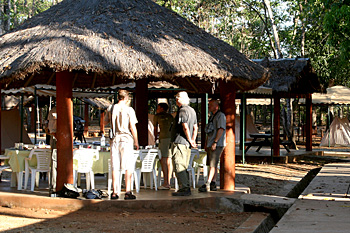
To get here we flew from Tana to Mahajunga and then drove for three hours to Ampijoroa. On the journey we connected with Madagascar Lark, Namaqua Dove and African Palm Swift. We stayed in the Ampijoroa Forest Station, where they have a few comfortable cabins (luckily we were allocated these) and many more tents. It was extremely warm here, making sleep difficult, but the fact that many birds and lemurs were seen directly from the cabin or breakfast table did help. The food was excellent too, cooked by one Harry from Mahajunga in a seemingly impossibly ill-equipped outdoor 'kitchen'.
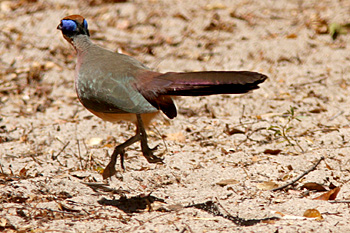
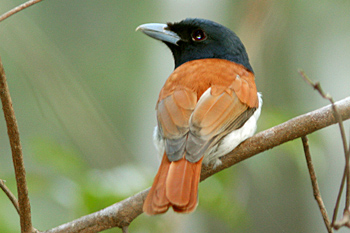
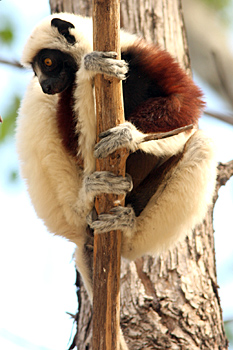
Birding in the camp was exciting right from the moment we got there. Our first good bird was the small Chabert Vanga, and we also found Hook-billed Vanga nest-building, and Blue and White-headed Vangas actually in the camp. Common birds which we got to grips with here included the spectacular Crested Coua, Crested Drongo, Madagascar Bulbul, and Madagascar Magpie Robin. Also we had the huge and interesting Lesser and Greater Vasa Parrots, the only birds which have penises (actually hemi-penises, or cloacal eversions....). The harsh calls of Sickle-billed Vanga accompanied us at breakfast on both mornings, and there was a large local troop of Coquerel's Sifaka and a couple of shy Mongoose Lemurs in the camp.
We had quite a rude awakening one morning at 5.30am as Fano, Jackie and Olga (the latter two being our local guides) found a Banded Kestrel, so after an unplanned morning jog up the hill, one or two of us got onto it. Luckily the rest of the group caught up with this bird in Ifaty later on. The toilets, as always in the tropics, were also productive for wildlife - often a welcome distraction! Here there were dozens of frogs living in the cisterns, and lurking above in the men's toilet was a Mahafaly Sand Snake, which Rainer 'Steve Irwin' Summers, one of the Rockjumper guides, 'rescued'. After some close-up views, the animal was released away from the toilet block.
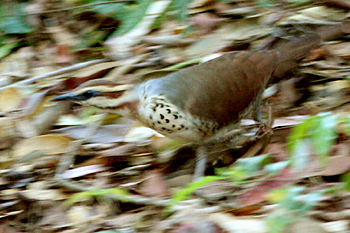
In the forest the birding was relatively straightforward compared to later sites, and we had our first experience of birding with local Malagasy guides. The forest areas in particular seem to have very low density of birds. For special or difficult birds the technique seemed to be for the group to wait until the bird was located by the guides, who would then 'round up' the bird and coax it towards the group. We found this quite difficult and frustrating, but it did seem to work. This technique got us two White-breasted Mesites running across the path, and also Van Dam's Vanga - after a lengthy and nail-biting wait in the midday heat.
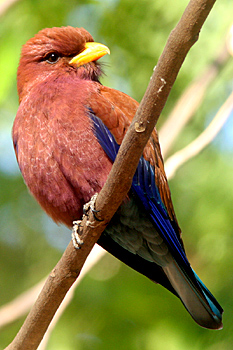
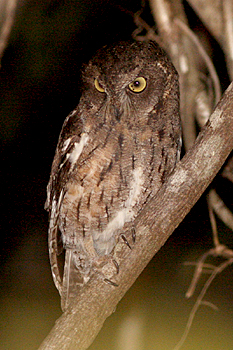
Other birds found by more conventional means on forest walks were Long-billed Greenbul, Madagascar Sparrowhawk, Buzzard and Green Pigeon, as well as the huge Madagascar Cuckoo-Roller. This bird was seen at several sites on the trip calling loudly and displaying in a spectacular fashion high above the canopy. We also had a rather tame Rufous Vanga which allowed us to take some good photos, and we also found Red-capped and Coquerel's Couas in the forest. At night, we managed to get onto the Torotoroka Scops Owl, which posed beautifully for photos. However, the most exciting moment was when we found at least five Schlegel's Asities high up in the canopy, possibly indulging in some kind of lekking behaviour. This was so exciting we even failed to connect with a Madagascar Cuckoo-hawk which flew out from the next tree!
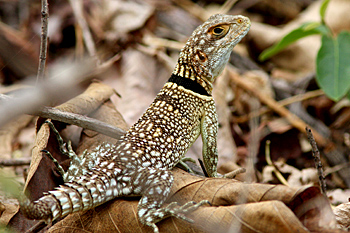
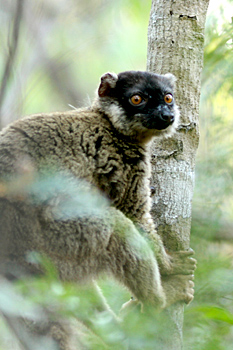
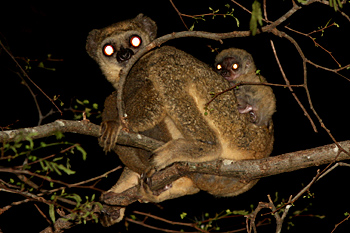
Other wildlife that we encountered included a superb juvenile Oustalet's Chameleon, Common Brown Lemurs and the first of the brilliant sportive lemur species - Milne-Edwards' Sportive Lemur. These all seemed to be hiding in holes in trees, peering out with startled wide eyes looking terrified - incredibly cute! In the camp we saw plenty of Cuvier's Iguanids and the first of many Madagascar Day Geckos. On a night walk there were two Tuft-tailed Rats with great furry tail tips, Rhinoceros Chameleon, Western Woolly Lemur and several Grey Mouse Lemurs. We did miss the Golden Brown Mouse Lemur, but you always need something to go back for.
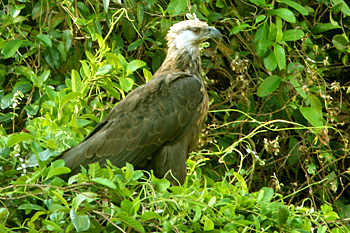
Down at Lake Ravelobe the star bird was undoubtedly a perched Madagascar Fish Eagle, and we also had Madagascar Jacana, Three-banded Plover, Glossy Ibis and distant views of White-throated Rail in terrible light. The last of these turned out to be Simon's 3000th bird! Also, near the bridge, we had plenty of Mascarene Martins, Sakalava Weavers and a pair of Long-billed Green Sunbirds.
Nearby at Lake Amboramalandy, we added some 'easy waterbirds' and others - the deeply uninspiring Madagascar Cisticola, Little Grebe, African Pygmy-goose and a Whiskered Tern.