Tenerife & Fuerteventura,
December 2005
11th December
After a very cold 0500 start, and an unproblematic run to Gatwick, we caught our 0930 flight (deeply unfamiliar territory, this package holiday lark!). The baggage reclaim took an age, but we eventually picked up our mini-Chevrolet hire car and headed off towards the north of the island, through (initially) very arid terrain.
We got to Puerto de la Cruz by late afternoon, and settled in at the Casablanca Apartments. Not many birds yet - we've both seen Yellow-legged Gull and Kestrel, and Julia saw a Sparrowhawk and heard what were surely Plain Swifts. But no firm ticks yet....
12th December
After a not very peaceful night (baby in the next door room etc.), we set off shortly after 0700, headed for the famous Monte del Agua site in the north-west of Tenerife. We got a bit lost en route, diverting via a seaside backroad, and having to take a severe switchbacking detour, but we eventually got there, not long after 0815. We immediately scored with several endemic species and forms.
Island Canaries were common and easy to see right by the entrance track, as were Canaries Chiffchaffs, their rather thick and deep (even gruff) song being quite distinct from European birds. Equally startling were the Tenerife African Blue Tits - much darker about the head than our birds at home, with contrastingly white cheeks, plain blue wings and different vocalisations. The Canary Islands Chaffinches were remarkably different - strangely plain and dull, and again with a song more like a Chiffchaff on steroids! The Tenerife Goldcrests we saw were more subtle, but their long bills and very buff underparts made them look pretty sound as different.
The best 'cryptoendemic' by far, however, was the local superbus form of Robin, which was, well, SUPERB! With a sharp pale eye-ring, redder and more distinctly cut off throat, different bill structure, and a quite different song and call, surely this is ripe for splitting! The local Buzzard (insularum) was les impressive, however, and the endemic form of Blackbird was underwhelming!
But we were here for two big target species - and we fortuitously found our own excellent lookout point over the forest, on a left hand hairpin, opposite a rock grotto with a white splodge of paint. We were after the endemic pigeons, and within five minutes, we had had decent flight views of both Laurel (the rarer one) and Bolle's Pigeons!
Further exploration of the track down to the 'traditional' lookout provided perched views of two Bolle's Pigeon, and flight views of several more, and we had a brief (but good) view of another Laurel Pigeon. While the diversity was (of course) very low, we were well-entertained with a really interesting selection of birds.
The return walk was long and mostly uphill, and took us until lunchtime. After a slap-up picnic, we visited Erjos ponds, adding Snipe, Greenfinch and Teal to the list, along with Coot and Moorhen.
We were pretty tired, and bird activity had all but dried up, so we headed back to the hotel for a non-birding afternoon, involving nap, tea and general laziness. This trip ain't no Peru!
13th December
Another fairly early start, but a shorter drive, with an inevitable wrong turning! But we found our way up the northern flank of Mount Teide (fresh snow on the very top!), and successfully found the Zona Recreativa de Chanajiga, a nice little area of laurel forest on very steep slopes. We saw several Bolle's Pigeons, but sadly no Laurel Pigeons at all, in addition to a few of most of the commoner passerine species. Overhead, we had Sparrowhawk, Kestrel and Buzzard, and a large flock of Plain Swifts (our first).
With the sun getting up, we decided to head for the heights, and drove up through the Canarian Pine-clad slopes, stopping for a quick break at a picnic area - and right on cue, there were both Tenerife Blue Chaffinch and the Canaries form of Great Spotted Woodpecker! All going to plan so far....
We spent a little time in the visitor centre at El Portillo, looked around their botanic garden and had a coffee, and then pushed on up to 2500m and the foot of the cable car. Here, over lunch, two very tame Berthelot's Pipits finally got themselves on our lists.
The fantastic volcanic scenery was the best bit of today, in truth - great jumbled lava fields, pumice 'beaches', blocks of obsidian and contorted hummocks of basalt. Fantastic stuff in fantastic weather, too!
We took the cable car ride up to the top (well, nearly - you need a permit and a serious dose of fitness to get to the very top), and enjoyed amazing views of the north and east of Tenerife from 3555m - pretty short of air up here. And with the sulphurous stench from the active fumaroles all around us, there was a real sense of tiptoeing around on a sleeping giant! The summit was lifeless, apart from a very few mosses and a single green plant clinging on among the rocks just beside a steaming fumarole.
We were down by 1430, and enjoyed several more Berthelot's Pipits among the rocks. We drove on, to the southern flank of the volcano, and successfully found a few Tenerife Blue Chaffinches at the famous Los Lajas picnic site, along with more Island Canaries, Tenerife African Blue Tits and Great Spotted Woodpeckers. But we were both getting pretty tired, so we drove back across the spectacular caldera, with lots of 'oooh-ahhh!' photo stops, and redescended the southern side towards Puerto de la Cruz, via another Tenerife Blue Chaffinch among the pines.
With slow traffic on the narrow and winding road down, it wasn't exactly an express journey, but we got home in good time for dusk, and enjoyed another relaxing evening and early night.
14th December
A slightly less early start, and up to the Anaga Peninsula, via heavy traffic on the motorway and some winding mountain roads. The weather was not too clever today - cool and chilly with some brief showers, and above all a bit breezy for a lot of bird activity.
We found the Pico del Ingles lookout point, and disappointingly had just brief views of three Bolle's Pigeons, and no Laurel Pigeons at all. A highly photogenic Tenerife African Blue Tit entertained by the balcony, and a Sparrowhawk swooped over the dizzying precipice - all a bit gut-wrenching if you thought too hard about how far down it was!
We drove on along densely forested and very twisty mountain roads, and screeched to a halt when two largish birds appeared overhead. A quick exit from the car, and we locked on to good but brief views of two Barbary Falcons sparring high over the ridge. Excellent!
We pushed on, but the rain became ever more persistent, and we didn't see much, albeit it in truly spectacular (and lush) volcanic mountain scenery. We descended precipitously to the village of Taganana on the north coast - few birds here either, but we did see a couple of the famous and rare 'Dragon Trees' growing apparently wild on an inaccessible cliff ledge.
After lunch back at Pico del Ingles, we headed back, failing to find the reservoir en route, but heading for a lazy afternoon back in the hotel. That accomplished, we hit the town of Puerto de la Cruz (Whimbrel on the lava shore, Sandwich Tern offshore) for a slap up meal at the Pomodora Restaurant, set in a grotto cave under the cliff face. Very scenic and romantically moonlit. Woefully 'flup'! Groan....
15th December
After a night of flamenco 'enterntainment' and the evils of the crying baby once again, we were grateful to have a scheduled slow morning - and was it SLOW! We packed our (double) overnight bag, enjoyed a wander around the Jardin Botanico (complete with Monk Parakeets and a more prosaic European Chiffchaff in song), had a coffee with an English newspaper, and then headed off to the Tenerife Norte airport to catch our 1320 Binter flight to Fuerteventura.
It left early, and arrived 10 minutes ahead of schedule - this we like. The car hire pick up was less slick - rather than having an office, Record Spain had a rather tired and harassed looking rep sat on a bench in the arrivals areas with a clipboard. She described the format as 'Bohemian' - but with an upgrade to a AC Citroen Xsara, we weren't complaining.
We did the dude's thing, and headed like so many before us straight to the Barranco de Rio de Cabras, just 1km north of the airport. At the very first stop to check directions, we flushed a small party of Black-bellied Sandgrouse, and then had good views of four of them on the deck - great start!
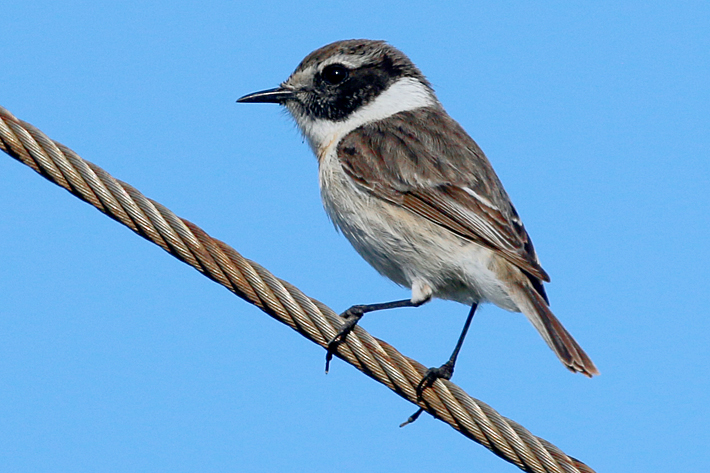
We found the barranco OK, and headed off into the mid afternoon heat - more sandgrouse within seconds! Once in the valley itself, we quickly started to see a few Berthelot's Pipits - but this wasn't the main target, of course. Then, connection! Julia found a male Canary Islands Stonechat on a small boulder, and instantly turned up her second tick in under five seconds in the shape of a party of Trumpeter Finches. We didn't know which way to look. But once we'd calmed down, we had great views of both species - the chat was joined by a female, and even started singing. There's something so special about true single island endemics, and now we've seen five in the Western Palearctic (Scottish Crossbill (dodgy!), Red Grouse (also a bit dodgy in my view...) Corsican Nuthatch and Finch, and now this). Simon also snatched a quick view of a Spectacled Warbler - Julia could only hear it singing.
On the way back to the car, a spectacular Saker Falcon (complete with bells and jesses!) careered past, circled a few times and even looked as if it wanted a feed - no sign of falconer, and nothing we could do to help it.
We then hit the road, and drove for just on an hour to the south. En route, a group of three birds in flight over the road resolved for a second or two into Cream-coloured Coursers: but we need better views! We reached Costa Calma, and checked in to our perfectly adequate apartment (Morasol) with some daylight left, so it was off to the famous 'sandy plain' for a recce. We connected with a nice Spectacled Warbler and two singing Great Grey Shrikes of the very dark Canaries koenigi form, but couldn't find any of the true desert specials in the gloaming. But at least we now know where to park in the morning!
16th December
Another early start, but only a very short drive to be on site at 'the sandy plain' by 0700, and into the field at once, ready for dawn.
Almost at once, we saw Spectacled Warbler, two Barbary Partridges (quite distantly), and soon after that Great Grey Shrikes started to sing, and a few very high-flying Mediterranean Short-toed Larks bombed overhead. The first of perhaps 30 Black-bellied Sandgrouse exploded from the desert, and flew past, giving excellent views.
But after about half an hour, our no.1 target bird appeared. Simon picked up a dark shape among the bushy dune vegetation, and sure enough, there was an adult African Houbara pacing stealthily about. Result! We later saw two more of these magnificent and increasingly scarce beasties.
We eventually reached the cliff top on the far (northern) side of the peninsula, and turned left to make a broad loop, exploring the more sandy area to the west. Pretty quickly, after yet more sandgrouse, we found our other major target - at least a dozen Cream-coloured Coursers, superbly camouflaged in the desert, until they took flight, when their jet black underwings were a bit of a giveaway!
Thoroughly satisfied with our haul, we returned for an elevenses break which turned into a lunch siesta - hard work, this ticking lark..... In the early afternoon, we headed off to Morro Jable and the Jandia peninsula proper. We were generally pretty underwhelmed - it's essentially very arid, very quiet and not even that scenic. Certainly, we struggled for birds for a lot of the time, but we did eventually get some quality, especially at two spots. 4.4km past the end of the metalled road, we found an abandoned farm with some leaky water pipes, as well as 100+ Spanish Sparrows; we also had many Linnets and some Trumpeter Finches here, plus a very tame female Canary Islands Stonechat on a breeze block wall. Also near here we saw two 'large' falcons, most probably Barbary Falcons, but too briefly to be 100% sure of eliminating Peregrine.
Further on, 7.8km from the end of the metalled road, a wide barranco full of the endemic Euphorbias handiensis also contained an excellent pair of Canary Islands Stonechats, not 200m uphill from the road, as well as the more predictable Spectacled Warbler and Berthelot's Pipit.
Back at Costa Calma shortly before dusk, we saw a pre-roost gathering of some 20 White Wagtails, and back out in (a slightly different part of) the sandy plain, managed to locate our one missing desert species: nine very dark insularum Stone-curlews.
Well satisfied, and with just one full day to go, we had a slap up Italian meal in the pretty gruesome resort of Costa Calma, and retired for yet another early night.
17th December
Guess what? Another early start, and back out onto the Costa Calma sandy plains. We again saw almost the full suite of target species - 24 Cream-coloured Coursers, 19 Black-bellied Sandgrouse, an African Houbara, several Mediterranean Short-toed Larks (including a 'scopable one on the deck), Great Grey Shrikes, Spectacled Warbler and Ravens - but again no Stone-curlews. We also had a large falcon sp. overhead, against the sun - it was probably a Peregrine, but we could not quite rule out Barbary Falcon.
After a morning siesta and clearing up our room, we checked out of Costa Calma, and headed north into the interior, and the well-genned site of Las Peñitas, near Betancuria. We quickly scored with Sardinian and Spectacled Warblers, lots of Spanish Sparrows, insularum Buzzard, dacotiae Kestrel, a few Song Thrushes and a heard only Robin, presumably of the nominate form. But (bizarrely) the big bird was the degener form of Blue Tit - our last (potentially significant) taxonomic target of the trip. We scored with about five or so, in a dense tamarisk thicket. I've said it before in England: if a bird like a Blue Tit was a major rarity, then people would work really hard to see them!
We also had some good insects - Scarlet Darter, Emperor, (?)Vagrant Emperor, Blue-tailed Damselfly sp., Plain Tiger & Greenish Black-tip.
Disaster (well, near-disaster) struck at the far end of the barranco: Simon went over on his ankle and sprained his left ankle pretty badly. It took 20 minutes or so to get moving again, and it was slow progress back up to the car. But it ended up serviceable, and more importantly driveable (with care and gingerness...)
We dropped in at Betancuria for a bit of cultural tourism and an ice cream. The 1410 Cathedral is well worth a visit for its gaudy but effective devotional art - especially the amazing 'Ship of the Church' piece!
Then onwards via the very windy mountain road to Antigua, then down to the east coast again and a brief stop at Las Salinas - Sandwich Tern, Whimbrel, Turnstone, Common Sandpiper, Kentish and Ringed Plovers, Dunlin and Redshank all present, plus a flock of Trumpeter Finches and yet more Berthelot's Pipits. We'd not seen a single swift, either Plain or Pallid, on Fuerteventura.
We had a paella by the seafront at El Castillo, and then got to the airport in good time for our flight back to Tenerife - all went to plan.
We got back quite late, with yet more amplified crooning from the bar to contend with, and the news that our flight home has been put back to tomorrow at 2040, six hours later than planned. While this does give us more time to get going in the morning / in the field, we could really have done without getting back to Gatwick at 0100 on Monday morning.....grrrr.
18th December
We had a late start (no surprise there) - Simon's foot was not in a great state, but was at least usable (and drivable!). After checking out, we drove back to the very first site we had visited - Monte del Agua near Erjos. While the injury prevented a long hike back into the laurel forest, we had a good hour around the access track, primarily in search of better views of Canary Islands Chaffinch - we had a decent view, but were left a bit dissatisfied, and with only poor photos. But Island Canaries were showing well everywhere, along with superbus Robins and all the other common landbirds, plus a few Buzzards.
Onwards along the western edge of Tenerife, and past the horrors of Playa de las Americas and Los Cristianos, before seeking out the alleged oasis of Roquita del Fraile reservoir along the south coast. It took a bit of finding, but eventually we found a track running due west from El Fraile town which took us to within a few metres of the tank. Essentially it was a concrete pond in the middle of a rubble strewn mess, among walled and covered banana plantations - a typically unpleasant southern European 'hot spot'! At least it wasn't a rubbish dump.
Instantly, we connected with the hoped-for long-staying Nearctic rarity - a fem/imm Blue-winged Teal, which had arrived way back in October, swimming about with a female Shoveler (of the Nearctic form, one wonders?). Also here were such exciting rarities as Cormorant, lots of Coots (checked carefully), Little Ringed Plover, Spotted Redshank, Redshank, Greenshank, Dunlin, Common Sandpiper, Barbary Partridge and Spectacled Warbler.
By now we'd had enough, and we headed up the foothills of Mount Teide one last time for an hour in a quiet spot by the road, enjoying a last few insects and plants, Plain Swifts, and not least our last warm sunshine until Easter!
We finally checked in at 1830 or so, and the flight eventually left at about 2100 - 150+ pretty disgruntled passengers returned to Gatwick at the absurd hour of 0150 - we didn't get to bed until 0330....ouch.
Overall
An excellent little trip! Just 65 species in total, but eight Canarian endemics, a further two Macaronesian endemics, numerous cryptospecies and distinctive forms, some desert specialities and even a Nearctic vagrant thrown in for good measure.
Species | Notes |
Grey Heron | One in flight over central Fuerteventura |
Little Egret | Five on Tenerife, and one on Fuerteventura |
Shoveler | A female at Roquita del Fraile, Tenerife |
Blue-winged Teal | The long-staying first-winter or female was at Roquita del Fraile, Tenerife |
Common Teal | Two first-winters or females at Erjos Ponds, Tenerife |
Sparrowhawk | Six sightings on Tenerife |
Buzzard | Five sightings on Tenerife (mostly near Erjos), and 3 near Betancuria, Fuerteventura. These were birds of the form insularum - we noted few differences from European birds, except for an apparently prominent pale bar across the darkly streaked breast of more than one bird |
Kestrel | 13 sightings of canariensis birds on Tenerife, and 12 of dacotiae birds on Fuerteventura. The latter were rather distinctive, with deeply buff-suffused underparts, at least on the males we saw well |
Barbary Falcon | Two seen extremely well over the Anaga peninsula, Tenerife. Also two probables at the Jandia peninsula, Fuerteventura |
Peregrine Falcon | One over Icod de los Vinos, Tenerife (carrying a pigeon), and a probable at Costa Calma, Fuerteventura |
[Saker Falcon] | [An obvious escape (complete with bells and jesses) circled us at very close range at Barranco de Rio Cabras, Fuerteventura] |
Barbary Partridge | Three at Costa Calma, Fuerteventura, 30+ at Las, Fuerteventura and one at Roquita de Fraile, Tenerife |
Moorhen | 20 at Erjos Ponds, Tenerife |
Coot | One at Erjos Ponds, Tenerife, and 40 at Roquita de Fraile, Tenerife. All were checked carefully for the presence of American Coot, without success.... |
African Houbara | One of the big targets of the trip. We succeeded in finding three and one adult birds on successive mornings at Costa Calma, Fuerteventura. These birds are of the endemic east Canarian form, fuerteventurae |
Stone-curlew | Nine at Costa Calma, Fuerteventura. Hayman et al. describe the east Canarian form (insularum) as sandier and paler than the nominate form - but we found the birds we saw to be notably dark streaked and inky looking. |
Cream-coloured Courser | Another enormous target bird - after seeing three very briefly in flight in central Fuerteventura from a moving car, we saw 10 and 24 at Costa Calma on successive mornings. The local birds here are of the very sandy-coloured Canarian form bannermani |
Common Snipe | Three at Erjos Ponds, Tenerife |
Grey Plover | One at Las Salinas, Fuerteventura |
Little Ringed Plover | Three at Roquita de Fraile, Tenerife |
Kentish Plover | Two at Las Salinas, Fuerteventura |
Common Ringed Plover | About 15 at Las Salinas, Fuerteventura |
Turnstone | About 10 at Las Salinas, Fuerteventura |
Dunlin | Five at Las Salinas, Fuerteventura, and a further 3 at Roquita de Fraile, Tenerife |
Common Sandpiper | Two at Las Salinas, Fuerteventura, and another at Roquita de Fraile, Tenerife |
Whimbrel | Two at Puerto de la Cruz, Tenerife, and a further 3 on Fuerteventura |
Greenshank | One at Costa Calma, Fuerteventura, and another at Roquita de Fraile, Tenerife |
Common Redshank | Two at Las Salinas, Fuerteventura, and another at Roquita de Fraile, Tenerife |
Spotted Redshank | One at Roquita de Fraile, Tenerife |
Lesser Black-backed Gull | A handful noted amongst larger numbers of the following species |
Yellow-legged Gull | Common along all coasts. Apparently of the form atlantis, and certainly darker than and 'different' from standard Yellow-legged Gulls (michahellis). Nevertheless, the taxonomy of the Canarian birds is rather unclear - purists allow only Azorean gulls as atlantis |
Sandwich Tern | A total of about 20 noted offshore |
Black-bellied Sandgrouse | About 65 sightings on Fuerteventura, nearly all at Costa Calma. Some duplication is likely from day to day |
Rock Dove/Feral Pigeon | While a few possible 'pure' birds were seen in remoter sites, the vast majority were deeply diluted 'town pigeons' |
Bolle's Pigeon | About 15 at Monte del Agua, Ten (two seen perched at close range), 5 at Chanajiga, and about 5 at Pico de Los Ingles, Anaga Peninsula, Tenerife |
Laurel Pigeon | Three or perhaps four seen (in flight only) at Monte del Agua, Tenerife |
[Barbary Dove] | [Two apparent risorias seen on Tenerife] |
Collared Dove | Present on both Tenerife and Fuerteventura |
Monk Parakeet | Three at Puerto de la Cruz, Tenerife |
Plain Swift | Surprisingly scarce - just three contacts, all on Tenerife. 150 over Chanajiga, 10 over Puerto de la Cruz, and finally 5 over the southern flank of Mount Teide |
Hoopoe | About a dozen on Fuerteventura, including six together on a busy roundabout in Costa Calma |
Great Spotted Woodpecker | Three of the endemic form canariensis (deeply suffused buff below, very extensive red crissum, creamy neck, shoulder patch and possibly stubbier bill than nominate) in the pine forests on Mount Teide |
Mediterranean | Eleven of the small, sandy-coloured form polatzeki around Costa Calma, Fuerteventura |
Berthelot's Pipit | Rather scarce in northern Tenerife - we had to wait until our ascent of Mount Teide to see our first (at 2800m!) But we saw more at Roquita de Fraile, and also saw 100+ on Fuerteventura |
Grey Wagtail | Eleven sightings on Tenerife - of the endemic form canariensis |
White Wagtail | Twenty at Costa Calma, Fuerteventura, and another at Roquita de Fraile, Tenerife |
Robin | We saw about 15 and heard others on Tenerife. These birds were of the highly distinctive form superbus, which is surely an incipient cryptospecies. The bird looks remarkably different from rubecula, with a deeper red, better demarcated breast, a more obvious, whiter eye-ring, and a quite different voice - calling almost like a Chaffinch! By contrast, we heard a typical-sounding Robin on Fuerteventura, where superbus does not occur |
Canary Islands Stonechat | One of the critical targets for the trip. We connected with a pair at the famous Barranco del Rio Cabra site near Fuerteventura airport within an hour of landing, and then saw a further five birds - three on the Jandia peninsula (perching on Euphorbia jandiensis!) and one at Las Peñitas |
Blackbird | Quite common on Tenerife in well-wooded habitats, but absent on Fuerteventura |
Song Thrush | Three at Las Peñitas, Fuerteventura |
Spectacled Warbler | Seventeen sightings on Fuerteventura, and one at Roquita de Fraile, Tenerife |
Sardinian Warbler | A handful seen and heard on Tenerife, and about 10 at Las Peñitas, Fuerteventura |
Blackcap | Some ten seen and heard on Tenerife |
Common Chiffchaff | One in song at Puerto de la Cruz, Tenerife, and three at Las Peñitas, Fuerteventura, where the following species does not occur |
Canary Islands Chiffchaff | Common and highly visible on Tenerife, especially in wooded areas. The song of this fairly newly-split species is more insistent, louder and a little more sibilant than Common Chiffchaff. To the eye, differences are subtle, but the endemic species does seem to show consistently paler legs |
(Canary Islands) Goldcrest | About 15 seen on Tenerife, but hard to observe closely. Longer bill, buffy underparts and different wing pattern all noted, however, along with a subtly different call |
African Blue Tit | The teneriffae form on Tenerife was common and easy to see - a very striking bird with a solid blue-black cap, quite plain ultramarine wings and a strikingly white, contrasting cheek patch. Vocally distinct from European Blue Tit, too. The more subtle but also distinctive Fuerteventura form, degener, was much harder to find - we eventually saw about six in a tamarisk thicket at Las Peñitas |
Raven | The only corvid of the trip - some 20+ sightings (with repetition) on Fuerteventura |
Great Grey Shrike | About 25 seen on Fuerteventura, and one at Roquita de Fraile, Tenerife. These birds were of the very dark endemic form, koenigi, most closely related to the North African races. The song was perhaps the most remarkable feature - a very short and simple repeated "brrr-teeep!" rising on the second syllable |
Spanish Sparrow | Inexplicably unobserved on Tenerife, but not uncommon on Fuerteventura, with a large flock of 150+ on the Jandia Peninsula |
Canary Islands Chaffinch | About 15 at Monte del Agua and two on the Anaga Peninsula, both Tenerife. Dove blue-grey across the whole back/mantle, oddly framed diffuse eye-ring, pinkish-buff below and sounding like House Sparrows. |
Tenerife Blue Chaffinch | Seen well in the pine forests of Mount Teide, both at the famous Las Lajas picnic area (5) and at a smaller picnic area on the northern flank (2) |
Island Canary | Very common on Tenerife in all kinds of habitat |
Greenfinch | Three at Erjos Ponds, Tenerife |
Goldfinch | Three on Fuerteventura |
Linnet | 25 noted at three sites on Fuerteventura |
Trumpeter Finch | Fifteen at Barranco del Rio Cabra (sp?), 8 on the Jandia Peninsula, and a further 25 at Las Salinas, all on Fuerteventura. Of the form amantum |